

Delta Delays Tel Aviv Return From JFK and Atlanta
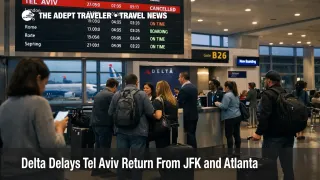
Delta Tel Aviv suspension tightened again on March 12, 2026, and the practical problem is no longer one single disruption window. Delta says New York's John F. Kennedy International Airport (JFK) to Ben Gurion Airport (TLV) is now paused through March 31, 2026, with the return leg from Tel Aviv to JFK paused through April 1, 2026. It also says Atlanta's Hartsfield Jackson Atlanta International Airport (ATL) to TLV is now paused through August 4, 2026, with the return side paused through August 5, 2026. For travelers, that means late March New York plans may still be a waiver and reroute problem, while Atlanta based Israel trips through much of spring and summer have become a rebuild now problem.
The Delta Tel Aviv suspension now creates two different traveler decisions. JFK travelers are dealing with a near term outage inside a broader security waiver window, while ATL travelers can no longer treat the Delta nonstop as an option for most of the summer schedule.
Delta Tel Aviv Suspension Now Splits Into Two Planning Windows
What changed on March 12 is not just another short extension. Delta's own update draws a hard line between its New York and Atlanta Tel Aviv plans. JFK to TLV is canceled through March 31, 2026, and TLV to JFK through April 1, 2026. Atlanta to TLV is paused through August 4, 2026, and TLV to ATL through August 5, 2026. Delta also says affected flights will be processed in its system on March 14, 2026, and customers will then receive cancellation notices through the Delta app and the contact information tied to the booking. That processing date matters because some travelers will see the disruption in public statements before the canceled segment fully lands in their reservation.
This sharpens the broader Middle East air service picture already developing across the market. Air Canada Extends Dubai, Tel Aviv Suspensions showed another North American carrier turning a short shock into a dated planning problem, and Middle East Airspace Closures Ground Gulf Hubs remains the baseline for why even partial regional reopening has not restored normal schedule reliability. Delta's update adds a more specific U.S. layer, because it removes one March nonstop from New York and pushes one key southeastern U.S. nonstop far into summer.
Who The JFK And Atlanta Delay Hits Hardest
The most exposed JFK travelers are those with departures in the second half of March who were still hoping Delta might restore service before month end. They now have a published no fly window through March 31 from New York, which means tight itineraries built around a same day arrival into Israel are harder to defend. If the trip includes a land tour start, family event, religious visit, or cruise or overland connection that depends on reaching Israel on a fixed date, the risk is not only the long haul cancellation. The real risk is losing the whole chain behind it.
Atlanta travelers face a different problem. August 4 is not a routine short extension. It is a signal that the ATL nonstop should be treated as unavailable for the spring and much of the summer booking horizon unless Delta changes course again. For travelers in the Southeast, that removes a cleaner single carrier option and pushes demand into alternate U.S. gateways, European connections, or non Delta solutions much earlier in the planning cycle. Waiting for the nonstop to come back may save a preferred itinerary on paper, but it can also burn better backup inventory while other passengers are shopping the same limited alternatives.
Delta's waiver language gives some flexibility, but it is not a blank check. Delta says impacted TLV travel dates now run from February 28 through April 30, 2026. Customers can rebook through February 28, 2027, and fare differences are waived when the new itinerary stays in the same cabin and travels on or before that date. Delta also says customers can cancel for a refund of the unflown portion or take an eCredit. At the same time, it warns that changes to origin or destination may trigger a fare increase, which means a creative self repair that shifts the trip into another city pair may not remain cost neutral.
Why This Delta Cut Raises Misconnect And Hotel Risk
The first order effect is straightforward, fewer Delta operated seats from the U.S. into Tel Aviv. The second order effect is where travelers lose money. Once a nonstop disappears, displaced demand pushes into European and U.S. connection banks, where the odds of a clean same day rebuild are usually worse, especially when many passengers are chasing the same remaining flights. Asia Europe Bypass Fares Spike on Replacement Routes already showed how quickly replacement inventory can tighten when normal Gulf and Middle East pathways stay unreliable.
A connection bank is the cluster of arrivals and departures an airline uses to feed onward traffic through a hub. It matters here because a rebuilt itinerary that looks acceptable on paper can still fail operationally if the first transatlantic leg runs late, if passport or security processing takes longer than expected, or if the onward Tel Aviv sector has little slack left in the day. That is why this kind of suspension often turns into extra hotel nights, missed tours, and weakened protection for separate ground bookings, even when the passenger does eventually get a replacement long haul seat.
For Israel trips with fixed on the ground timing, the most realistic backup is usually not the cheapest one. It is the routing that preserves protection and buffer. In practice, that often means a single ticket with one stop, or an intentional overnight at the connection point, rather than a tight same day self built chain across separate bookings. The tradeoff is simple, a faster itinerary may look better in search results, but a slower protected itinerary is often the one that actually gets you to the start of the trip.
What Travelers Should Do Before Delta Processes Cancellations
JFK travelers booked through March 31 should not wait for the March 14 system processing if the trip is time sensitive. Delta explicitly says customers do not need to wait for the cancellation notification to make changes. If the trip still matters, the next decision point is whether the waiver can preserve the trip on acceptable terms, or whether the smarter move is to cancel and rebuild around a different carrier or different dates.
ATL travelers booked before August 4 should treat the Delta nonstop as effectively off the board for now. That does not mean every replacement itinerary is good. It means the planning logic changes. If your Israel arrival is tied to a fixed event or onward ground plan, prioritize protection over fare and avoid same day onward commitments after arrival. If your trip is discretionary and the Israel segment is the most fragile piece, canceling early may be the cleaner choice. Travelers using separate tickets, separate hotel bookings, or cruise and tour joins should also review supplier cutoff rules now, because the money loss often comes from the layers behind the flight, not the canceled flight alone.
The bottom line is that Delta Tel Aviv suspension is no longer one uniform March story. JFK is a late March disruption with a waiver path attached. Atlanta is a much longer reset that should push travelers to reprice and reroute now, not later. The sooner you sort your booking into short hold or full rebuild, the better your chances of protecting the rest of the trip.