

KLM Extends Dubai, Tel Aviv Suspensions Into April
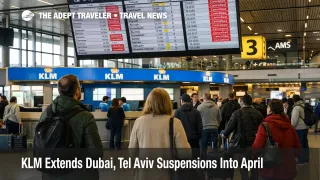
KLM Middle East suspensions now come with firmer outer dates, which is the real traveler shift. KLM's live alert page says flights to and from Dubai, Riyadh, and Dammam are suspended through Saturday, March 28, 2026, while Tel Aviv remains suspended through Saturday, April 11, 2026. For travelers booked through Amsterdam Airport Schiphol (AMS), that turns a rolling disruption into a spring planning problem with a clearer deadline. If your itinerary depends on a KLM connection into the Gulf or Israel, this is the point to review the whole trip, not just the canceled segment.
The practical consequence is bigger than one missing nonstop. KLM also says it is not currently flying through the airspace of Iran, Iraq, and Israel, nor over several countries in the Gulf region, which helps explain why the airline is holding multiple markets offline at once. That matters most for travelers using Amsterdam as a connector between North America, Europe, Africa, and parts of Asia, because once one regional leg disappears, the rest of the itinerary often has to be rebuilt around a different hub or a different carrier.
KLM Middle East Suspensions, What Changed
The new fact is not simply that KLM is still disrupted, it is that the airline has published harder end dates across several markets. According to KLM's current schedule alert, Dubai, Riyadh, and Dammam are suspended up to and including March 28, 2026, and Tel Aviv is suspended up to and including April 11, 2026. Reuters also reported this wider date ladder, which confirms the change is no longer a day to day operating question.
That changes traveler behavior because fixed dates push spring trips out of the "wait a few days" category. A short disruption can sometimes justify patience. A suspension running to late March or mid April usually does not, especially if the itinerary includes a cruise embarkation, a fixed hotel sequence, a conference, or a separate onward ticket. KLM already had to harden its Dubai and Tel Aviv positions earlier this month, but this update makes the spring horizon clearer and widens the share of travelers who need full replanning instead of a simple delay buffer.
Which Itineraries Are Most Exposed Via Amsterdam
The most exposed travelers are the ones for whom Dubai, Riyadh, Dammam, or Tel Aviv were not the real final decision point, but rather the last hinge in a longer trip. Amsterdam to Dubai cancellations hurt on their own, but the second order damage rises when Dubai was supposed to feed South Asia, East Africa, a Gulf resort stay, or a cruise departure. The same logic applies to Tel Aviv, where a missing KLM segment can force a different European hub, a longer travel day, or an overnight that was never part of the original plan.
Mixed ticket itineraries are even more fragile. If the long haul into Schiphol is on one ticket and the onward flight is on another, a KLM cancellation may not protect the rest of the trip the way a single through ticket would. Corporate travelers and premium leisure travelers are also exposed because Amsterdam is a common connection bank, and losing one KLM sector can reduce same day alternatives fast, especially while other carriers are also cutting or thinning Middle East flying. British Airways has already pushed several Gulf and Israel suspensions deeper into spring, and Lufthansa has published destination specific pauses into late March, early April, and late April, depending on the market.
What Travelers Should Do Now
Start with the ticket, not the route map. KLM says rebooking and refund options for the affected Middle East destinations apply to trips from February 28 through March 28, 2026, when the ticket was originally issued on or before March 2, 2026. For Dubai, Riyadh, Dammam, and Tel Aviv, travelers can rebook for a new departure on or before April 26, 2026, request a travel voucher valid for one year, or request a refund if the qualifying flight was canceled. For Tel Aviv, KLM also says a full refund may be available if the flight was delayed at least three hours in Europe or at least five hours on an intercontinental itinerary.
In practice, rebook now if the trip is time sensitive, built on separate tickets, or depends on a short onward connection through Amsterdam. Wait only if your travel dates are flexible, your destination is still optional, and you can absorb the risk that replacement seats tighten as more spring travelers shift into the same smaller pool of alternatives. If you do accept a reroute, prioritize survivability over elegance, meaning fewer handoffs, longer connection buffers, and one ticket whenever possible. For Israel bound travel, document and entry readiness still matter if the replacement itinerary changes airport, timing, or overnight logic, so Israel Entry Requirements For Tourists In 2026 is still worth reviewing before you confirm a new plan.
Over the next 24 to 72 hours, watch three things. First, whether KLM moves those end dates again. Second, whether more European network carriers align around similar longer suspensions. Third, whether Gulf hubs stabilize enough to make alternate routings more reliable rather than merely available. For context on the wider regional backdrop, Middle East Airspace Closures Halt Dubai, Doha Flights, KLM Suspends Amsterdam Tel Aviv Flights From March 2026, and British Airways Extends Gulf Flight Cuts to May 31 all show the same broader pattern, the region is not just disrupted, it is losing timetable certainty across multiple carriers and hubs.
Why the Disruption Spreads Beyond One Carrier
The mechanism is straightforward. When KLM stops serving several Middle East destinations and avoids large parts of the region's airspace, the damage is not limited to the canceled flight number. Aircraft rotations change, crews and slots have to be reassigned, partnership inventory tightens, and substitute hubs take on extra demand. First order, KLM passengers lose their planned flights. Second order, Amsterdam connection flows become less reliable, mixed ticket trips become easier to break, and replacement seats on other carriers get harder or more expensive to secure.
This is also why the KLM update matters beyond KLM customers. Dubai has resumed some flying, but Adept's March 17 coverage shows the hub remains fragile after repeat interruption, reduced schedules, and wider regional airspace risk. In that environment, a traveler should not read "airport reopened" as "network normalized." A hub can process flights and still be a poor place to trust for a tight same day connection. That is the real spring planning lesson here.
Sources
- Travel alerts and disruptions, KLM
- Airlines cancel more flights as Middle East conflict escalates, Reuters
- KLM Dubai Flights Canceled Through March 28
- KLM Suspends Amsterdam Tel Aviv Flights From March 2026
- Middle East Airspace Closures Halt Dubai, Doha Flights
- British Airways Extends Gulf Flight Cuts to May 31
- Lufthansa Middle East Suspensions Stretch to April 30
- Israel Entry Requirements For Tourists In 2026