

U.S. Airport Recovery Risk Stays Live After House Move
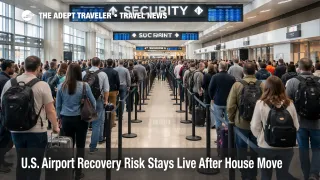
U.S. airport recovery risk stayed elevated in the United States on March 28, 2026, after the House rejected the Senate's broader DHS funding path and instead passed a short stopgap bill through May 22. For weekend travelers, that means the political headline changed again, but the operating problem at the airport did not suddenly clear. TSA has started the process of paying officers after emergency executive action, yet several major airports are still warning passengers to arrive far earlier than normal, which tells travelers the recovery phase is still uneven, and still fragile.
U.S. Airport Recovery Risk: What Changed
What changed late on March 27 was not a clean resolution, but a chamber split. The Senate had already passed a bill to reopen most of DHS while leaving out Immigration and Customs Enforcement and Border Patrol funding. House Republicans rejected that approach and passed their own short term bill to fund the full department through May 22. AP reported the House vote was 213 to 203, and Senate Democratic leaders signaled the House plan was effectively dead on arrival, while senators had already left Washington, which makes a quick legislative repair less likely. That leaves travelers with a real distinction between payroll relief for TSA and full political resolution for the wider department.
The practical point is that resumed pay can help arrest the staffing spiral, but it does not instantly rebuild checkpoint throughput. Reuters reported that more than 3,450 TSA officers did not show up for work on March 26, including more than one third at New York John F. Kennedy International Airport (JFK) and at airports in Baltimore, Houston, and Atlanta. Reuters also reported lines of four hours or more, the worst in the agency's history. In an earlier Adept Traveler article, U.S. Airport Delays Stay High After House Rejects TSA Fix, the core warning was that House resistance could keep the airport problem alive even after Senate action. That is now the confirmed operating picture.
Which Travelers Face the Most Exposure This Weekend
The most exposed travelers are people departing from big hubs with concentrated morning banks, families checking bags, travelers using smaller airports with limited staffing slack, and anyone trying to protect a fixed same day event such as a cruise embarkation, wedding, tour departure, or final flight of the day. At George Bush Intercontinental Airport (IAH), Houston Airports is still warning that the shutdown is affecting TSA staffing and that security is operating only in Terminals A and E, with longer than normal waits. Hartsfield, Jackson Atlanta International Airport (ATL) is telling travelers to allow three hours to clear security during peak periods. Baltimore, Washington International Thurgood Marshall Airport (BWI) went further on the morning of March 28, warning that checkpoints A and B were closed, delays were significant at Checkpoint C, and travelers should arrive four hours before departure.
That matters because uneven recovery is harder to plan around than a universal shutdown. One airport may look passable while another is still operating with closed lanes, reduced checkpoint footprints, or slower screening flow. First order, travelers hit longer security lines and a higher chance of missing the scheduled flight. Second order, the damage spreads into forced hotel nights, weaker same day reaccommodation, more pressure on rental cars, and spillover to alternate airports as travelers try to salvage the trip. In an earlier Adept Traveler signal, Airport Security Delays Could Outlast the Shutdown, the warning was that staffing recovery would lag the headline fix. The live airport advisories on March 28 support that view.
What Travelers Should Do Before Leaving for the Airport
Travelers flying this weekend should keep buffer in the plan, not remove it because Congress moved again. At airports posting explicit warnings, normal domestic timing is too aggressive. If your airport is telling you to allow three or four hours for security, treat that as the baseline, not the worst case. Anyone checking bags, traveling with children, parking off site, returning a rental car, or changing terminals should add more time on top of the airport's own advisory.
The next decision point is whether your itinerary can absorb failure. Rebook early, or move to a later departure or a nearby airport, if missing the first flight would break the whole trip. Wait if your departure airport is running normally, your schedule has slack, and your airline is not warning about security related disruption. The better signals are local, not political. Watch for checkpoint closures, unusually early arrival guidance, suspended PreCheck or lane consolidation, and airport specific advisories tied to screening rather than weather. In an earlier Adept Traveler article, Senate Deal Leaves U.S. Airport Weekend Risk Live, the focus was that operational proof mattered more than rhetoric. That remains the right threshold.
Why the Recovery Is Still Uneven, and What Happens Next
The mechanism is straightforward. Funding and pay can stop part of the immediate financial pressure, but airport screening is a trained labor system, not a switch. Officers who have quit do not come back automatically. Attendance patterns do not normalize in a single day. Large hubs also need enough experienced staffing to absorb peak departure banks, irregular operations, and the usual frictions of bag drop, terminal circulation, and late arriving passengers. That is why a separate executive pay action for TSA can help without solving the broader U.S. airport recovery risk on its own.
What happens next depends on two tracks. The first is legislative, where the House and Senate remain split and the Senate path for the House bill looks doubtful. The second is operational, where travelers should look for airports to drop emergency advisories, reopen normal checkpoint footprints, and step down extreme arrival guidance. Until those signs appear consistently, the safer assumption is that U.S. airport recovery risk remains live through the weekend, especially at the biggest hubs and at thinner staffed airports with less room for error.
Sources
- DHS orders payment of 50,000 US airport workers in emergency action
- Effort to restore Homeland Security funding founders in Congress, Trump says will pay airport security workers
- Trump signs order to pay TSA employees after Congress fails to agree on DHS funding
- How the Homeland Security deal unraveled and split Republican leaders in Congress
- Houston Airports security wait times
- Hartsfield, Jackson Atlanta International Airport main page
- BWI departures advisory