

Lufthansa Reopens Larnaca as Regional Pauses Hold
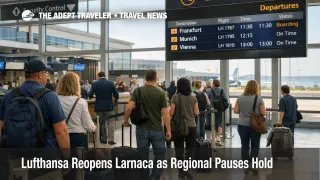
Lufthansa Larnaca flights resumed on Saturday, March 7, 2026, but that does not mean Lufthansa's wider Middle East network is back. Lufthansa's current travel information page says service to and from Larnaca, Cyprus, resumed on March 7, while Dubai, Abu Dhabi, and Dammam remain suspended through March 10, Amman and Erbil through March 15, Tel Aviv through March 22, Beirut through March 28, and Tehran through April 30. For travelers, the change is narrow but useful, because Cyprus has re entered the network as a workable edge gateway even while most of the main regional endpoints stay offline. The practical move now is to treat Larnaca as a selective staging point, not as proof that a broader Middle East recovery is underway.
This is the operational change from earlier Adept coverage. On March 6, the story was mainly a dated suspension ladder. On March 7, the traveler question is more specific, which nearby point is usable again, and whether getting there actually improves your odds of rebuilding the trip. In that narrower sense, Cyprus matters more today than it did yesterday, but it still comes with its own security and reliability caveats.
Lufthansa Larnaca Flights: What Changed for Travelers
What changed is not the regional risk picture, but the shape of the map. Lufthansa has reopened one nearby node, Larnaca, while keeping most of the higher exposure network shut for days or weeks longer. That matters because a resumed Larnaca flight can help travelers who are already in Cyprus, can safely reposition there from a nearby point, or need a Europe facing exit that does not depend on Dubai, Abu Dhabi, Amman, Beirut, or Tel Aviv reopening first.
That is a very different signal from a true hub recovery. Larnaca can support point to point recovery and some onward rebuilding into Europe, but it does not restore the broader hub logic that normally feeds long haul traffic across the Gulf and the Levant. Lufthansa is still telling customers on affected flights to check flight status before going to the airport, keep booking contact details current, and use refund or later rebooking options where flights were already canceled.
Travelers comparing this update with Lufthansa Middle East Suspensions Stretch to April should read the March 7 change as a narrow corridor opening on the edge of the disruption, not a reversal of the wider suspension pattern.
Which Travelers Can Use Cyprus as a Bridge
Cyprus is most useful for travelers who can reach Larnaca without depending on one of Lufthansa's still suspended destinations, and who are flexible enough to rebuild the rest of the trip from there. That could include travelers already on the island, travelers who had shifted to Cyprus earlier as a wait point, or travelers moving from parts of Europe where Larnaca remains reachable on separate tickets. It is less useful for travelers whose original plan still depends on Dubai, Abu Dhabi, Amman, Beirut, Tel Aviv, Erbil, Tehran, or Dammam reopening in time for a same chain recovery.
The catch is that Cyprus is not a zero risk fallback. The U.S. Department of State raised Cyprus to Level 3, Reconsider Travel, on March 3, and said non emergency U.S. government employees and family members were authorized to leave because of safety risks. The U.K. government is also warning that regional escalation is creating significant security risks and travel disruption. So Cyprus can function as a bridge only if you can get there safely, hold a confirmed onward plan, and accept that it is a staging point under regional pressure, not a carefree detour.
A related complication is that Cyprus is in the EU but not in the Schengen area, which means some travelers rebuilding itineraries through Larnaca may face a different document and connection logic than they would on an all Schengen reroute. That does not make Cyprus unusable, but it does mean tight self built transfers can become more fragile than they look at first glance.
What Travelers Should Do Now
Travelers with Lufthansa tickets involving Larnaca should verify that the specific flight is operating before moving, because one resumed destination does not guarantee a stable end to rolling schedule changes. Anyone whose itinerary still touches a suspended Lufthansa destination should assume the Larnaca reopening does not solve the original problem unless they can independently reroute the trip around the closure.
For travelers using Cyprus as a bridge, the key threshold is whether you can secure all three parts of the plan before you move, a confirmed inbound path to Cyprus, a room if an overnight becomes necessary, and a confirmed onward seat from Larnaca into Europe or wherever the trip is actually headed next. Without those pieces, repositioning can turn one broken itinerary into two. That risk is higher now because resumed service into a limited safe node often pulls sudden demand into hotels, short haul feeder seats, and airport transfers. Cyprus Travel Advisory Upgraded to Level 3 is still relevant for that decision.
Over the next 24 to 72 hours, monitor three things, whether Lufthansa adds more resumptions beyond Larnaca, whether Cyprus related advisories harden further, and whether onward Europe seats from Larnaca start tightening as more stranded travelers treat Cyprus as a bridge. The main benefit of Lufthansa Larnaca flights is optionality. The main mistake would be reading that optionality as normal regional recovery.
Why Larnaca Is Different From a Wider Recovery
Larnaca matters because it sits near the disruption zone without being one of Lufthansa's still suspended core problem points. In network terms, that makes it an edge gateway, a place where an airline can restore some passenger flow without claiming that the main corridor is stable again. That is why the reopening is useful, but limited. It gives Lufthansa one more operational foothold near the region while leaving the heavier exposure points shut until later dates.
The first order effect is straightforward, some travelers regain a usable Lufthansa option tied to Cyprus. The second order effects are where the pressure shows up. More travelers may now compete for Cyprus hotel rooms, same week short haul feeder flights, and onward seats into major European airports. That can create a misleading picture where the reopened leg looks healthy, but the rest of the recovery chain remains brittle. Adept's earlier reporting on Middle East Airspace Reopens, Closures Stay Fluid still fits that pattern, because partial reopenings can improve one slice of the system while leaving the overall network unreliable.
So the real traveler takeaway is narrow and practical. Cyprus is more usable on March 7 than it was on March 6, because Lufthansa Larnaca flights are back. But most of Lufthansa's regional suspensions are still in place, and Cyprus should be treated as a bridge for selected travelers, not as proof that the wider Middle East flight system has normalized.