

Pegasus Middle East Cancellations Hit Turkey Links
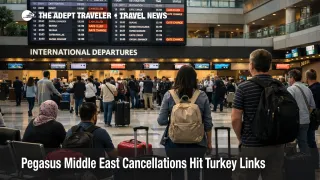
Pegasus Middle East cancellations have turned Turkey into a weaker recovery bridge just as many travelers were still treating Istanbul as a lower fare way back into the Gulf and Levant. Reuters reported on April 7, 2026 that Pegasus has canceled flights to Iran, Iraq, Amman, Beirut, Kuwait, Bahrain, Doha, Dammam, Riyadh, Dubai, Abu Dhabi, and Sharjah until May 1, and Pegasus' own notice confirms those markets are canceled through departures on April 30 and returns on May 1. The practical effect is broad, not niche. Travelers using Türkiye as a workaround now lose one of the region's biggest low cost connection maps, which raises the odds of pricier legacy fares, broken separate ticket plans, and extra hotel nights while waiting for replacement seats.
Pegasus Middle East Cancellations: What Changed
What changed is the width of the network hole. This is not one city pair dropping off the board. Pegasus' canceled list spans Iran, Iraq, Jordan, Lebanon, Kuwait, Bahrain, Qatar, two Saudi markets, and three UAE markets, which strips out much of the carrier's practical bridge role between Europe, Türkiye, and the Gulf. Because Pegasus is a large low cost operator centered on Istanbul Sabiha Gökçen International Airport (SAW), these cuts matter most for travelers who were counting on cheap one stop routings rather than full service protected itineraries.
The first itineraries to break are the ones built around price and flexibility rather than airline protection. A traveler flying Europe to Istanbul on one ticket, then Pegasus onward to Dubai, Doha, Riyadh, or Beirut on another, now has a much weaker salvage path. The same goes for travelers using Pegasus to exit a disrupted point in the Middle East and reconnect onward through Türkiye. Once the low fare layer disappears, the whole trip can reprice fast, especially when the onward segment was the one keeping the itinerary affordable in the first place.
This is also a sharper traveler problem than general Türkiye protest or advisory coverage. The issue here is network utility. Turkey may still be physically reachable, but Pegasus no longer offers a broad practical bridge onward into many of the markets travelers most need for recovery, family travel, business trips, or late spring repositioning. In an earlier Adept Traveler article, Lufthansa Middle East Cuts Deepen Summer Booking Risk, the warning was that European network cuts were getting longer. Pegasus now adds a lower fare Turkish layer to that same problem.
Which Travelers Lose the Most Flexibility
The highest exposure sits with travelers who need Türkiye as a bridge rather than as the destination. That includes people stranded in Europe trying to reach the Gulf at lower cost, passengers already in Türkiye trying to continue east, and anyone protecting cruise joins, work trips, medical travel, or family visits on fixed dates. Budget minded travelers are especially exposed because Pegasus often serves as the fare discipline layer beneath full service carriers. When that layer disappears, the replacement is usually not just different, but materially more expensive.
Travelers on separate tickets face the hardest failure mode. If the Europe to Türkiye leg still operates but the Pegasus onward sector is gone, the disruption moves from a schedule problem to a cash and logistics problem. Bags may need to be reclaimed, visa and hotel needs can change, and a missed onward segment may no longer qualify for through protection. That is the second order effect travelers often underestimate. The canceled flight is only the first hit. The larger damage comes when the remaining network has fewer same day backup seats and the traveler is forced into a new overnight or a full rebuild.
The least exposed group is travelers whose destination is simply Türkiye, or whose onward plan already sits on a stronger full service network. Qatar Airways said on April 1 that it is gradually rebuilding flights to more than 120 destinations by mid May 2026 through Doha, though it also made clear that flights still operate through dedicated corridors rather than a fully normal hub pattern. That means Doha is more usable than it was a few weeks ago, but it is still not a substitute for a normal, deep recovery bank. In an earlier Adept Traveler article, Qatar Doha Flights Expand, but Hub Risk Persists, that distinction was already central.
What Travelers Should Do Now
Travelers already ticketed through Türkiye should stop treating a cheap reassembly through Pegasus as the default fallback. The immediate move is to check whether the itinerary depends on any Pegasus segment to Iran, Iraq, Amman, Beirut, Kuwait, Bahrain, Doha, Dammam, Riyadh, Dubai, Abu Dhabi, or Sharjah, then decide whether the trip still works without it. If the answer depends on a separate ticket, a same day connection, or a last flight of the day onward leg, the safer move is usually to rebuild now rather than wait for a late reinstatement that may not come.
The least bad alternatives depend on what kind of trip the traveler is trying to save. For Doha bound or Doha connecting trips, Qatar Airways now offers a broader, though still constrained, network than it did in March. For Dubai bound travel from Türkiye, SunExpress still shows Dubai suspended only through April 30, with free rebooking or refund options for affected passengers, which may make it a cleaner Turkey based substitute once the calendar turns if the route actually restarts on time. For Saudi Arabia, airports remain open, but the route map around them is still fragile, so Riyadh or Dammam should be treated as usable only when the fare sits on a protected itinerary and the traveler can absorb delays or an overnight.
The key decision threshold is simple. If the trip's success depends on low cost flexibility through Türkiye, Pegasus Middle East cancellations are now a structural problem, not just a temporary inconvenience. Paying more for a protected legacy itinerary can be the cheaper choice once separate tickets, missed hotel nights, and forced airport overnights are priced in. Over the next several days, watch for any Pegasus extension beyond May 1, any broader restart signals from Gulf hubs, and any further European carrier cuts that would make Türkiye even less useful as a recovery bridge.
Why Turkey's Bridge Role Is Weaker Now
The mechanism is straightforward. In a stressed regional air system, travelers do not just need airports that are open. They need dense networks with enough spare seats and enough city pairs to absorb failure elsewhere. Pegasus normally helps provide that elasticity from Türkiye because it links Europe facing demand with lower fare onward flying into the Middle East. Removing that web does not close Turkish airports, but it does shrink the number of workable self rescue options when a first plan fails.
That is why this development matters beyond Pegasus alone. Lufthansa Group has already pushed a broad set of Middle East suspensions as far as May 31 and October 24, depending on market, which means the full service side of the recovery map is also thinner than normal. At the same time, alternative hubs are rebuilding unevenly. Qatar is expanding, but through managed corridors. Saudi airports are open, but operationally fragile. SunExpress still shows Dubai suspended through April 30. So the system is not closed, but it is missing the slack that normally lets travelers improvise cheaply and quickly.
What happens next depends on whether carriers start restoring depth, not just keeping a few routes alive. Until then, the right reading is blunt: Pegasus Middle East cancellations make Türkiye less valuable as a low fare bridge between Europe and the Gulf, and that changes planning now. Travelers who can still move should favor protected tickets, longer buffers, and routes that do not rely on a last minute low cost handoff in Istanbul.
Sources
- Airlines cancel more flights as Middle East conflict escalates, Reuters
- Flight Cancellations Due to Airspace Restrictions in the Middle East and Passenger Rights, Pegasus Airlines
- Qatar Airways Further Rebuilds Flight Schedules, Qatar Airways
- Current travel updates, SunExpress
- Lufthansa Middle East Cuts Deepen Summer Booking Risk
- Qatar Doha Flights Expand, but Hub Risk Persists
- Saudi Arabia Airports Open, but Flights Stay Fragile