

Global Air Travel Network Fragility Is Spreading
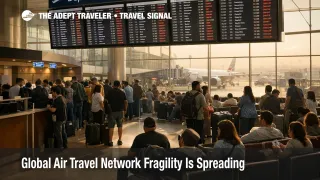
Global air travel fragility is becoming a clearer signal because several different kinds of stress are now hitting the same system at once. Middle East airspace disruption has already displaced aircraft, crews, and long haul routings. Jet fuel prices have surged hard enough to push fare increases and selective cuts. In the United States, the shutdown is weakening airport screening resilience just as heavy spring volume moves through the system. None of those pressures guarantees a system wide breakdown on its own. Together, they matter because airline networks are usually built to run tightly, not with deep spare capacity. When enough assets end up in the wrong place, the ripples stop looking local and start surfacing in other airports, other regions, and other parts of the trip.
Global Air Travel Fragility Is Showing in Multiple Stress Points
The signal to watch is not a single airport closure, one carrier canceling a route, or one fuel price headline. It is the widening mismatch between where the network expects its assets to be and where real world disruption leaves them instead. Aircraft that should be flying their next sectors can end up parked, delayed, or rerouted. Crews that should connect onward can time out, strand, or require repositioning. Ground systems that usually work as a predictable handoff, such as security screening, airport access, fueling, or aircraft turns, become less forgiving when the wider system is already carrying less slack.
That is why the current pattern looks more serious than a normal rough patch. In an earlier Adept Traveler article, Middle East Airspace Closures Raise Asia Europe Fares showed how closures in one region can force longer routings and tighter seat availability far beyond the Gulf. In another earlier Adept Traveler article, Middle East Airspace Reopens, Closures Stay Fluid made clear that even partial reopenings do not return the network to normal right away. Operations can restart before balance returns.
The fuel side is reinforcing that fragility. In an earlier Adept Traveler article, Jet Fuel Price Shock Hits Global Travel Planning tracked how the jump in physical jet fuel prices moved from an energy story into a traveler planning problem. In another earlier Adept Traveler article, U.S. Airfare Hikes Spread as Fuel Costs Double showed that some carriers are no longer just absorbing the hit. They are raising fares and cutting weaker flying. That matters because fewer marginal flights, fewer backup seats, and fewer cheap late booking options make the whole network less resilient when anything else goes wrong.
Where the Pattern Is Spreading, and Who Could Feel It Next
The most obvious pressure point remains long haul traffic linked to the Middle East, especially itineraries that depend on banked hub connections and precise crew flow. In an earlier Adept Traveler article, British Airways Extends Gulf Flight Cuts to May 31 showed how a temporary disruption can become a longer horizon inventory problem. Once carriers publish deeper cancellations and rebalance capacity elsewhere, the network is no longer just disrupted, it is being redesigned in real time.
But this is where travelers can misread the risk. The next visible failures do not have to appear where the original disruption started. A network under strain often breaks at its weakest secondary point, not its most famous primary one. That can mean a smaller airport with fewer TSA officers, a route with only one daily flight, a maintenance chain waiting on an aircraft that arrived late from another region, or a hub that suddenly has less room to reaccommodate passengers because carriers already trimmed marginal flying.
The U.S. adds a separate but connected vulnerability. In an earlier Adept Traveler article, U.S. Shutdown Threatens Smaller Airport Closures explained why checkpoint resilience matters more at smaller fields than at giant hubs. In another earlier Adept Traveler article, TSA Shutdown Delays Deepen at U.S. Airports showed how a screening problem can become an itinerary recovery problem even when aircraft and crews are otherwise ready. If the airport side becomes less reliable at the same time airlines are protecting margins with selective cuts, then missed flights become harder to fix.
That combination creates exposure well outside the headlines. Travelers could feel it on U.S. domestic trips feeding long haul departures, on Europe itineraries already facing fare and fuel pressure, on Australia domestic sectors that connect into international gateways, and on summer bookings at constrained hubs where schedules looked robust a few weeks ago but are now less certain. The traveler who notices only the original trigger may miss where the real vulnerability has moved.
What Travelers and Planners Should Watch Now
The right response is not panic, because the current evidence still points to a fragile system, not a universal collapse. But it is the wrong moment to assume the network will absorb surprises the way it usually does. Travelers with inflexible trips should treat this as a period where backup options matter more than the lowest fare.
For near term travel, the best threshold is connection dependence. If the trip relies on a short same day handoff, a small departure airport, a final flight of the day, or a cross region chain that cannot tolerate delay, reducing that dependency is the safer move. Earlier departures, longer connections, and one overnight before a long haul segment can look inefficient on paper, but they buy resilience when the system is carrying displaced stress.
For spring and early summer bookings, the next threshold is inventory quality. Higher fares alone are painful but manageable. Higher fares plus fewer fallback options are more serious. If airlines keep cutting weaker routes or thinning frequencies, then the traveler loses the ability to recover from a routine disruption without paying more, staying overnight, or abandoning part of the itinerary. That is where a normal delay becomes an expensive trip failure.
What to monitor next is fairly clear. Watch for more route suspensions being extended rather than shortened. Watch for more carriers describing fuel pressure in terms of capacity, not only price. Watch for airport specific screening warnings in the United States, especially at smaller fields. Watch for signs that schedule recovery is slowing even after airspace or weather conditions improve. Those are the clues that the network is not just busy, but materially out of balance.
Why the Pattern Could Trigger Bigger and Stranger Problems
Airline systems are usually more fragile than they look during calm periods. They work because fleets, crews, airport slots, ground handlers, maintenance windows, fuel supply, and passenger flows line up closely enough most days to keep the machine moving. The system does not need every asset to be perfect, but it does need enough spare room to recover when something slips.
The danger in the current setup is cumulative stress. Middle East disruption displaced assets and lengthened some routings. Fuel shock is pushing airlines to protect margins through price and network choices. The U.S. shutdown is weakening a critical airport choke point that sits outside airline control. Each issue hits a different part of the chain. That matters because multi point stress produces odd second order failures. A city with no fuel shortage headline can still lose flights if aircraft are elsewhere. An airport with no weather event can still run badly if crews miss sequence. A trip can fail before boarding because the checkpoint or landside process broke first.
This is also why surprise problems can appear where travelers least expect them. The system does not always telegraph fragility with a dramatic airport closure. Sometimes it shows up as a weak rebooking pool, a route quietly disappearing, a hub running without schedule margin, a regional spoke losing resilience, or a delay that should have been recoverable but no longer is. Those are not random annoyances. They are the visible symptoms of assets, labor, fuel, and recovery room all getting tighter at once.
The signal, then, is not that global aviation stops. It is that the margin for error is shrinking across several parts of the network at the same time. If some of the current stresses ease, the system can stabilize. If more aircraft remain displaced, if fuel pressure drives deeper cuts, or if U.S. airport screening deteriorates further, then the next stage is broader unpredictability, especially in places not yet at the center of the story. Travelers do not need to cancel everything. They do need to assume that hidden fragility is now part of the operating environment.
Sources
- Jet Fuel Shortage Risk Spreads Beyond Asia
- Jet Fuel Price Shock Hits Global Travel Planning
- Middle East Airspace Closures Raise Asia Europe Fares
- Middle East Airspace Reopens, Closures Stay Fluid
- British Airways Extends Gulf Flight Cuts to May 31
- U.S. Shutdown Threatens Smaller Airport Closures
- TSA Shutdown Delays Deepen at U.S. Airports
- U.S. Airfare Hikes Spread as Fuel Costs Double
- Europe Fare Hikes, Fuel Shortage Warnings Spread
- O'Hare Summer Flight Cuts Raise Booking Risk
- Australia Domestic Fares Rise as Virgin Moves